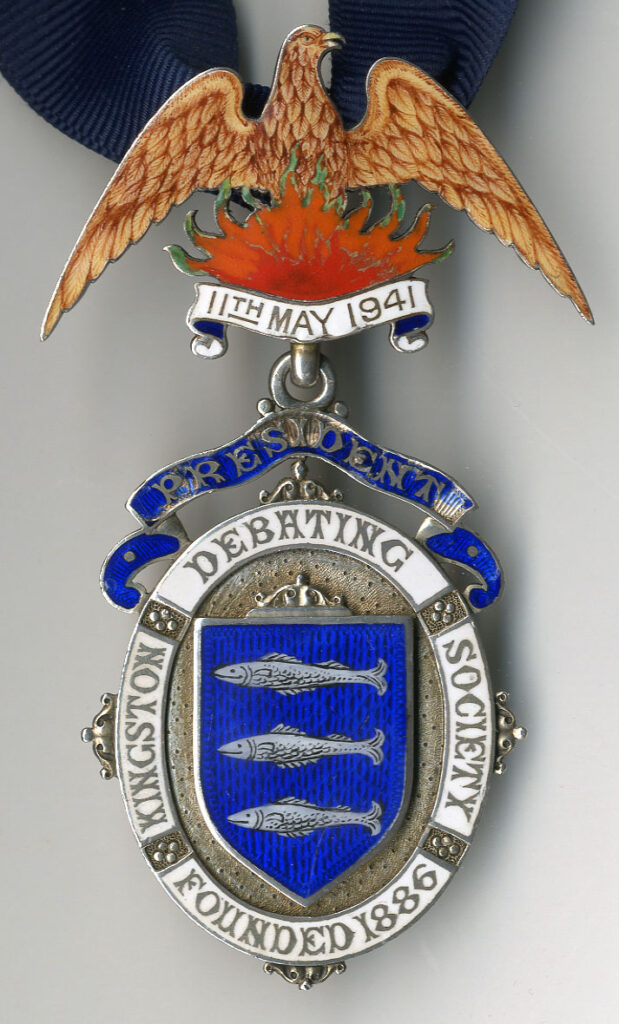
This page is in the course of preparation during the summer of 2026. Members are being invited to suggest why the Society appeals to them and to identify the aspects of debating they regard as valuable.
Dates in square brackets after members’ names denote the year they joined. Entries are in reverse date order of compilation, the earliest entry being the thoughts of the 2025–26 President uploaded in June 2026.
You have to play the ball, not the player
by Tony Bird [1972], August 2026
The Kingston Debating Society has been successful for 140 years. Why ?
I think that the key is the Ignorance Rule. That is, when we come to a debate we have to pretend that we know nothing about any of the other members – even though they may have been very good friends for many years.
This means that no one is allowed to say: ‘I’m very surprised that Mr Smith should say that – he’s a civil servant, and should know better.’ Nor can we say: ‘Ms Jones has changed her tune – she said just the opposite last week.’ Likewise, no one can say: ‘We shouldn’t listen to Charlie – he made a complete idiot of himself two weeks ago.’
So no ad hominem attacks are allowed. You have to play the ball, not the player.
Is there a better way to spend a winter’s evening?
by Peter Harris [2019], August 2026
Debating is a great example of an activity that can be both fun to participate in and an opportunity for self-improvement.
Being able to convey your thoughts and ideas in a clear, concise way that engages the listener is a life skill, be it in a business or social context. Like any skill, we learn by watching and listening to skilled practitioners and by practising in an environment where our initial, stumbling efforts will not be judged. The Society has some wonderful speakers from whom I have learned much about the art of rhetoric – and even after seven years of membership, I continue to do so.
I particularly enjoy the clever and amusing ways in which members use their wit to turn points previously made in the debate to their advantage. And no matter how well you think you understand a topic, you will invariably hear a speech that makes you think and challenges your preconceptions.
Intellectually stimulating, entertaining and amusing, with opportunities for self-improvement – all in a friendly and welcoming environment. Is there a better way to spend a winter’s evening?
Making friends and learning more about them
by Martin Power [1974], July 2026
The Kingston Debating Society (KDS) is friendly and welcoming. Meetings allow us to make friends and to learn more about them as they reveal new aspects of themselves in a succession of debates on a variety of motions. I have made many good friends at KDS and have grown to value them more over the years.
Our procedures help to promote reasoned and courteous debates. All speeches are addressed to the President, rather than to opposing speakers. No-one is permitted to refer to views expressed by another member or visitor during a previous debate, or in the world outside KDS. Each debate is a world to itself, a fresh beginning. The young and the old are on equal terms. Everything depends on the arguments presented on the night.
Speakers use their wits to turn to their advantage the comments made by others. Newcomers may be surprised at how lively and amusing debates often become.
Visitors are free just to listen, or to speak as briefly as they wish, in the floor debate. Everyone enjoys hearing a new voice offering a fresh point of view.
Once they are used to it, most people find that they enjoy speaking in debates. Debating is an innocent pleasure, provided that we give others their fair turns, and are ready to listen, too. KDS provides a structure where everyone who wishes has a fair chance to express their views.
The debating year includes summer outings and an annual lunch as well as the chance to gather after meetings at the pub to reveal the things we didn’t feel able to say during the debate.
I thought I could wing it . . .
by Peter Drysdale [1997], July 2026
One of the things I enjoy most are the personal anecdotes which often come as a big surprise, not necessarily pleasant.
In one of my early debates I proposed that Colin Dexter’s Morse and Lewis were better than Conan Doyle’s Sherlock Holmes and Dr Watson. Something of challenge for me not having ever read anything by either, but I thought I could wing it – until one member from the floor stood up and began “Speaking as Secretary of the Sherlock Holmes Society . . .”
Much later, having learnt my lesson, when I proposed that water should be renationalized I spent a few weeks researching the water industry and delivered my opening speech confident I would know more about the subject than anyone else. My proposer’s speech went well. Then the opposer stood up to make his maiden principal speech and began “I worked for two years as a consultant on the privatization of water.”
I could go on. And on. But permit me one last, rather poignant anecdote. In a debate about the nuclear deterrent, one member, a Japanese lady, stood up and said “My father was in Nagasaki when the Americans dropped the second atomic bomb.”
Seeing merit in someone else’s point of view
by Steve Gilmour [1981], June 2026
In the Kingston Debating Society Members volunteer to speak for or against a motion with others contributing from the “floor”. For me, the joy has been the opportunity to speak and listen without interruption. We inform each other, we learn from each other and, even if we are not persuaded to change our minds, we cannot help seeing merit in someone else’s point of view.
Some of us adjourn after debates to a nearby pub where the discussion is much more free ranging. But the fact that we can meet like this, as friends, after profoundly disagreeing in a debate is testimony to the respect we have shown each other.
I was welcomed on my first day more than 40 years ago and that feeling of welcome has never worn off. It continues to be extended to those wishing to dip their toes into the civilised art of debating.
. . . . . . . . . . .
An invitation from our Speaker Secretary –
What’s on your mind?
by Natalia Power [1974], July 2026
Debaters have sent in excellent accounts of the friendliness of our debating society and how civilised it is in a world that seems ever more acrimonious. I have enjoyed reading every contribution.
I should like to focus on the topics chosen by debaters. After all, these topics create the structure of the debating society. Members and visitors can send suggestions for debating motions direct to me by emailing < n_s_power@hotmail.com >.
So what’s on your mind? Are you interested in UK politics? There is no shortage of motions debating whether the political parties are doing a good job or not (quick answer, they’re not). Do you enjoy reading? Debates have covered most aspects of literature, from childhood books to Shakespeare, biographies, poetry . . .
Are you fascinated by UK history or world history? If so, there are motions that will interest you and keep you thinking long after the debate is over. Perhaps you enjoy the arts, or philosophy or what makes human beings tick. If so, there will be topics that draw you to the debates on Thursday evenings.
We look forward to seeing you and hearing what you have to say. Do drop in one evening. If you’re hooked, join us as a member.
Very best wishes,
. . . . . . . . . . .
Reflections in the Centenary History of the Society
Finally, these thoughts by three members are taken from the last chapter, entitled ‘Reflections’, of the Kingston Debating Society’s centenary history published in 1986.
Here we may gain greater enlightenment
by Francis Geldart [1899], 1920
[He discusses how debating enables us to understand one another better by regularly entering into debate] This not once, or twice, but repeatedly; not on one favourite topic guardedly stereotyped and politely referred to, but pursuing a succession of propositions, varied and dissimilar, not with dogmatic assertion . . . but in the face of skilful criticism; not with those of a like type only, but by questioning and answering all or any sort of minds.
Here we may hope, beside learning more of our own strength and weakness, to know much more of those we so often elbow with ignorant thoughtlessness as we pass through life. Here we may . . . gain greater enlightenment, some measure of modesty, respect for others, in a word an approximation to a knowledge of real value, which schools, society, business, and all the reticence and self-conceit arising therefrom will fail to give . . .
Long may it [the Kingston Debating Society] continue to flourish and increase the debt which many owe.
Unrehearsed, uninhibited and unrecorded
by Richard Worthington [1976], 1986
The pursuit of truth is increasingly important in these days of Watergate, Chernobyl and Westland. Probably at no other time in history have individuals been so subjected to pressures, propaganda and sales pitches. To retain a sense of proportion, perspective and balanced judgement it is invaluable to hear the independent opinions of companions whose only objective, apart from scoring debating points and votes, is to inform, instruct and even to entertain their colleagues. Colleagues who, like themselves, have an appetite for hearing all three sides of an argument.
News coverage in newspapers, on television and radio is frequently curtailed or interrupted, with little or no chance of participation or development of interesting aspects. The two hours of speeches devoted to a single subject in our debating chamber provides the opportunity for full airing of a subject and often for quite unsuspected aspects of a subject to emerge.
The intellectual exercise of marshalling arguments, drawing them to a conclusion and the decision-making involved in voting is vital for free thinkers, and today’s society is in need of all the free thinkers it can muster.
The entertainment attraction of the Society is not, of course, merely that of learning something new, but of observing the gladiatorial skills of the principal speakers, particularly when one of them succeeds in retrieving an apparently lost cause. There is often the surprise of the voting. The whole proceedings are ‘live’; unrehearsed, uninhibited and unrecorded.
A forum that is welcoming
by Margaret Bird [1972], 1986
A disciplined, formal approach to debating is exceedingly important for safeguarding free speech. The moment heckling or serious interruption is permitted that vital attribute is lost. Happily the standards of courtesy and restraint in the KDS are extremely high. Also the fact that each floor speaker can speak only once and for a limited period is important; no single participant can hijack the evening and dominate the House. If the Society is to survive towards 2036 and — dare we hope? — towards 2086 it should surely resist any temptation to develop into a seminar or discussion group . . .
The Society plays a useful role in encouraging the skills of public speaking. In almost all walks of life, despite the modern developments in the field of computers and communications, there is still a need for individuals to be able to stand up and speak clearly and coherently . . . The KDS offers an ideal means of perfecting these skills. It is a forum that is welcoming and not hostile towards inexperienced speakers. If the new speaker does not want to say much at first it does not matter in the least. Many very effective floor speeches have been only three or four sentences long . . .
For me over the past fourteen years the most rewarding feature of the KDS has been the opportunity it affords for a systematic and concentrated consideration of a single subject without any interruption. No meal is served, no hot drink brewed, no errand run in the car, no telephone rings and no secondary conversation develops.
[source: M. Bird and R.G. Worthington, The Kingston Debating Society: The first hundred years 1886–1986 (1986), pp. 366–9. Richard Worthington died in 2010 aged 83, debating to the last; Margaret Bird is still a member in 2026.]